
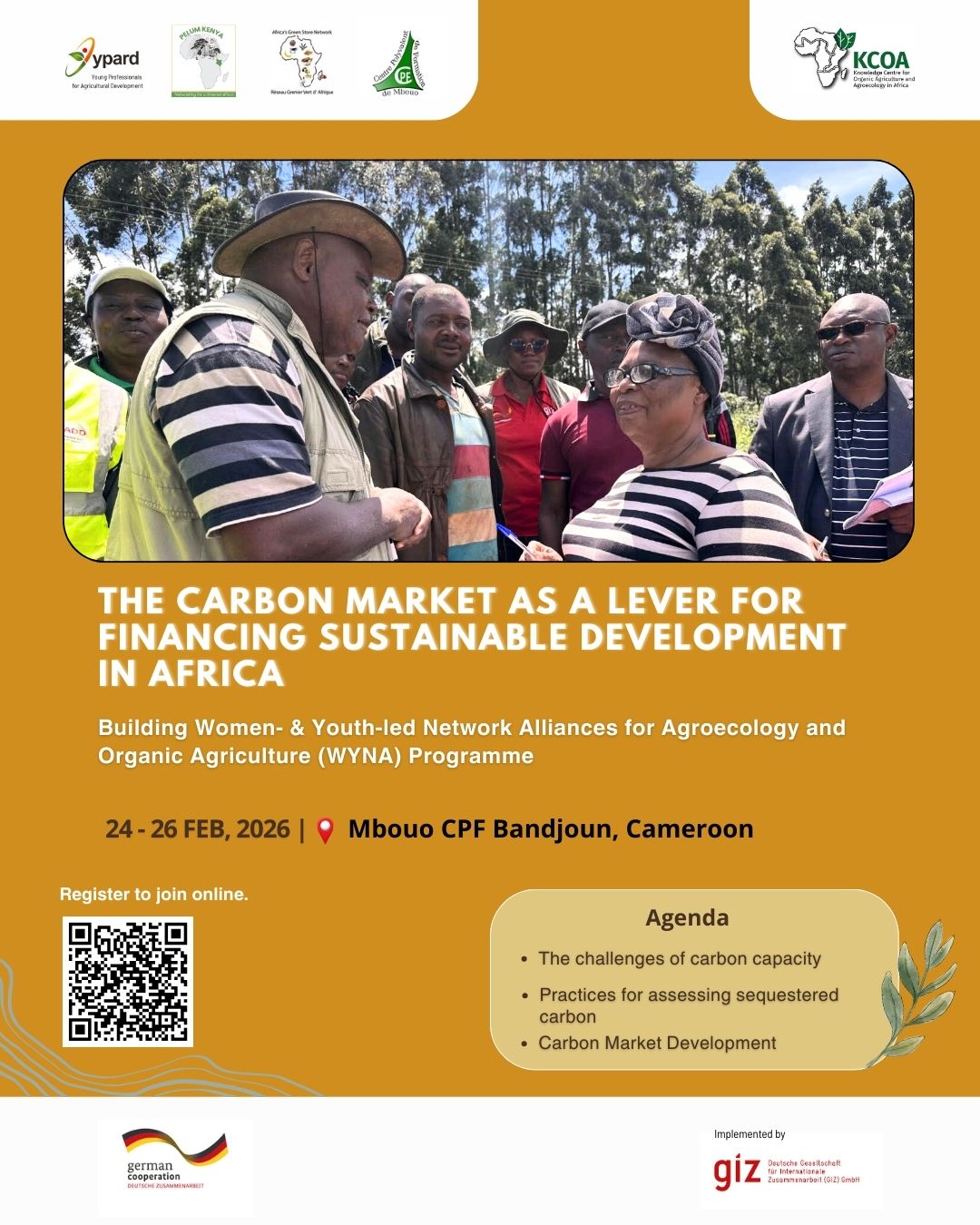
As Africa confronts the realities of climate change, soil degradation, and economic vulnerability among smallholder farmers, a new opportunity is emerging at the intersection of agroecology, carbon markets, and green revenue generation. In response, the African Green Store Network (AGSN), in collaboration with Economic and Social Council of Cameroon, EBZ-Dresden Germany, YPARD and PELUM Kenya, is convening a high-level continental conference from 24–26 February 2026 at the Centre Polyvalent de Formation (CPF) in Mbouo, Cameroon.
Organized under the project “Building Women- & Youth-Led Network Alliances for Agroecology and Organic Agriculture”, and funded by GIZ under Knowledge Centre for Organic Ariculture (KCOA), the conference positions the carbon market as a strategic lever for Africa’s agricultural resilience and economic sovereignty.
AGSN’s vision is clear: Africa’s agroecological transition should no longer be perceived as a constraint, but as a source of ethical, traceable, and high-quality carbon credits. By standardizing greenhouse gas emission reduction and carbon sequestration practices across its network, AGSN aims to integrate African producers especially young people and women into global carbon markets.
With 36 vocational training centers, universities, and partner NGOs across 12 African countries, AGSN offers a unique platform capable of:
Scientific research and policy frameworks increasingly recognize carbon sequestration as a triple-win solution for climate mitigation, soil restoration, and rural livelihoods. Studies by CIRAD, CIFOR-ICRAF, IRD, and the University of Liège demonstrate that agroforestry and organic practices significantly increase soil carbon stocks while improving food security and biodiversity.
Aligned with the Nairobi Declaration on Fertilizers and Soil Health (2024) and national policies from MINADER, MINEPDED, and MINFOF, this conference responds to Africa’s urgent need for credible structures to measure, certify, and valorize carbon impacts.
The conference will bring together 50 participants from eight African countries, including young producers, researchers, policymakers, development partners, and carbon market professionals. Key objectives include:
Expected outcomes include a pilot carbon inventory at the Mbouo CPF, strengthened technical skills among participants, and the launch of a collaborative dialogue space - the “Carbon Window” to advance African participation in climate finance.
By transforming training centers like CPF Mbouo into technical hubs for carbon market development, AGSN and its partners are laying the foundation for a just, inclusive, and climate-smart agricultural future one where African farmers are not only climate victims, but key actors in global climate solutions.
Africa’s carbon potential is real. The time to structure it is now.
Name
Organization
Designation