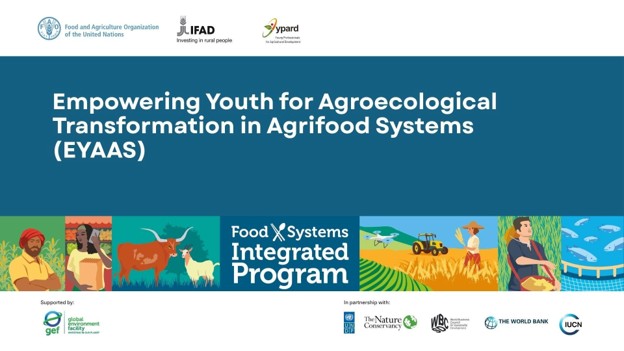

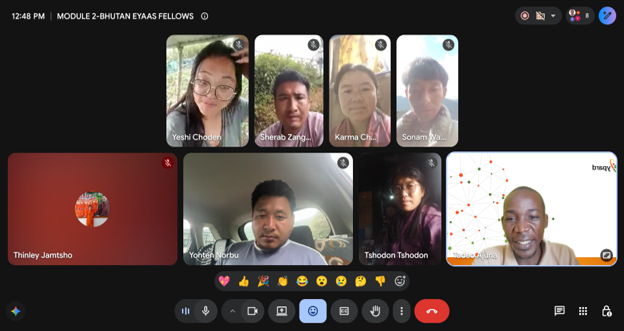
The Young Professionals for Agricultural Development (YPARD) continues to empower the next generation of agroecology leaders through the Empowering Youth for Agroecological Transformation in Agrifood Systems (EYAAS) programme, implemented under the GEF-8 Food Systems Integrated Program (FSIP). On 23 July 2026, the first cohort of EYAAS Fellows in Bhutan successfully completed Module 2 of the training programme, building on the earlier completion of the Introductory Module and Module 1. This marks another important milestone in equipping young professionals with the knowledge and skills needed to champion sustainable agrifood systems and agroecological transformation.
The EYAAS programme is designed to provide young agricultural professionals with a comprehensive understanding of agroecology and its role in creating resilient, sustainable, and inclusive food systems. Throughout the first three learning modules, the Bhutan fellows have explored a range of foundational topics, including:
These sessions have enabled participants to deepen their understanding of agroecological concepts while strengthening their capacity to apply sustainable approaches within their own communities and agricultural contexts.
EYAAS is a comprehensive six-module learning programme that equips young agricultural professionals with the knowledge, practical tools, leadership skills, and professional networks needed to drive agroecological transitions. Beyond technical learning, the programme encourages participants to critically examine current food systems and identify locally appropriate solutions that promote biodiversity, healthy soils, climate resilience, and sustainable livelihoods. The successful completion of the first modules by the Bhutan cohort demonstrates the enthusiasm and commitment of young professionals to becoming agents of change within their communities.
The first EYAAS cohort will engage more than 30 young professionals across Bhutan, Costa Rica, and Mexico, creating opportunities for cross-country learning and collaboration. Following the successful rollout of the programme in Bhutan, preparations are now underway to onboard fellows from Costa Rica and Mexico, whose training modules are scheduled to begin in the coming weeks. As the programme expands, it will continue to strengthen a global network of young agroecology champions working towards more sustainable and resilient agrifood systems.
Reflecting on the learning experience, Yonteb Norbu, an EYAAS Fellow from Bhutan, shared:
"The EYAAS training has been a truly rewarding learning experience. The Introduction to Agroecology module has deepened my understanding of Bhutan's existing farming systems. Through the sessions so far, I have gained valuable knowledge on agroecological principles, biodiversity, soil health, and resilient farming practices. Most importantly, the training has inspired me to think about how these concepts can be applied in my community. I look forward to putting this knowledge into practice and sharing the benefits of agroecology with farmers and communities."
His reflections highlight one of the programme's key goals: empowering young people not only with knowledge but also with the confidence and motivation to translate learning into meaningful action.
As the Bhutan fellows continue their learning journey through the remaining modules, they will further strengthen their technical expertise, leadership capacity, and practical skills in agroecology. Through the GEF-8 Food Systems Integrated Program (FSIP) and the EYAAS programme, YPARD remains committed to investing in young leaders who are driving the transition towards sustainable, resilient, and inclusive agrifood systems. By equipping youth with the tools to lead change, the programme is helping build a new generation of agroecology champions capable of shaping the future of food systems both locally and globally.